Philosophy
The throat chakra, or vishuddha
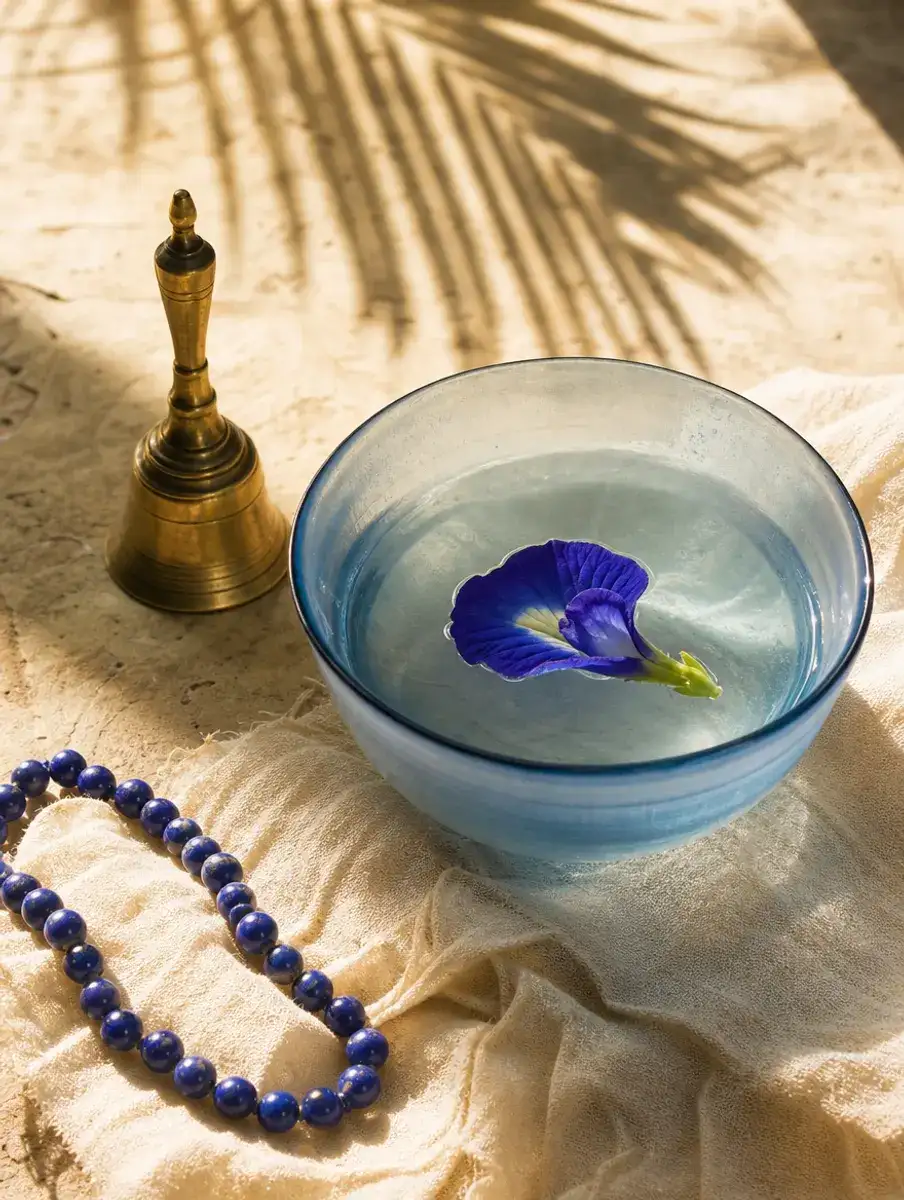
The throat chakra is vishuddha, the fifth of the seven chakras in the modern system, placed at the throat. Tantric and hatha texts picture it as a smoky purple lotus with sixteen petals, linked with the element of space (akasha) and the seed syllable ham. It is a traditional symbol, not a physical structure.
The throat chakra is vishuddha, the fifth of the seven centres in the modern chakra system. It sits at the throat, above the heart centre and below the point between the eyebrows.
This page describes vishuddha as the texts and the tradition describe it. It makes no claim that a chakra exists physically, can be blocked or opened, or that any practice changes it.
What does the throat chakra look like in the texts?
The fullest description comes from the Sat-cakra-nirupana, a sixteenth-century text that shaped the seven-chakra system most people know today. Its English translation, published in 1919 as The Serpent Power, carried this picture to the rest of the world.
In that text, vishuddha is a lotus with sixteen petals, smoky purple in colour. The sixteen Sanskrit vowels are written on the petals, one on each. At its centre is a white circle, compared to the full moon, which stands for the region of space.
Each centre in the system has its own element, syllable, animal and presiding figures:
- Element: akasha, usually translated as space or ether, the subtlest of the five elements.
- Seed syllable: ham.
- Animal: a white elephant.
- Presiding figures: Sadashiva, a form of Shiva, and the female deity Shakini, as the text names them.
The five lower centres each hold one of the five elements, from earth at the base up to space at the throat. Above vishuddha, the texts move beyond the elements altogether, to ajna, the centre between the eyebrows, and then the crown.
Why is it linked with speech and sound?
The throat is where the voice is made, so the link with sound is easy to see. The vowels on the petals connect this centre with the letters of the Sanskrit alphabet, and space, its element, was linked in Indian thought with sound.
Modern writers built on this. Many books now link the throat chakra with communication and honest speech. That reading is a twentieth-century development rather than something stated in the Sanskrit texts, but it grows out of the older connection with the voice.
Where does the rainbow colour come from?
The blue you see on most chakra charts comes from a Western system that gives each centre one colour of the rainbow. The pairing with the thyroid gland, and the lists of emotions or traits tied to each chakra, are modern additions too. Scholars of tantra usually treat this material as a new layer, not part of the older tradition.
How does vishuddha come up in a modern class?
In most classes the throat chakra comes up as a place to rest your attention. You might notice the throat during a humming breath, while chanting a mantra, or during the soft sound of ujjayi breathing, which uses a slight narrowing at the back of the throat.
Some postures draw attention to the front or back of the neck. Matsyasana, or Fish Pose, opens the front of the throat. In a supported shoulder stand, the chin moves toward the chest, close to the shape the hatha texts call jalandhara bandha, the throat lock. In both, a good teacher will remind you to keep the neck comfortable and never to push it.
If a teacher uses chakra language, treat it as a focusing cue. Placing your attention on the throat as you hum is a way to settle, not a claim about what happens inside.
The crown of the head, the last centre in the system, has its own page on the crown chakra, sahasrara.
Browse all yoga philosophy pages.
Sources: Mayo Clinic, Fitness program: 5 steps to get started; NCCIH (US National Institutes of Health), Yoga: Effectiveness and Safety. Last reviewed 2 October 2026.
Questions
What does vishuddha mean?
Vishuddha is usually translated as especially pure or purified. It joins the prefix vi, which intensifies, with shuddha, pure. Some writers spell it vishuddhi. Both forms refer to the same centre at the throat.
What colour is the throat chakra?
Modern charts make it blue, as part of a rainbow running from red at the base to violet at the crown. The older Sanskrit description is different. The Sat-cakra-nirupana describes a smoky purple lotus with a white, moon-like circle at its centre.
What is the bija mantra of the throat chakra?
In the tantric texts the seed syllable, or bija, of vishuddha is ham. It is the syllable of the element of space, which this centre is said to hold. Some classes chant it aloud, but chanting it is optional and makes no claim about the body.
Is the throat chakra connected to the thyroid?
That pairing is a twentieth-century addition. Western writers matched each chakra to a gland, and the throat was paired with the thyroid. The Sanskrit texts do not make that link, and there is no evidence that chakra practice affects the gland.
Can the throat chakra be blocked?
The Sanskrit texts do not describe chakras as blocked or unblocked. That idea is a modern addition, and this page makes no claim that any practice opens a chakra. Humming or chanting with attention at the throat can be a calm focusing practice. A sore throat, hoarse voice or trouble swallowing is a question for a doctor.
What is the throat chakra said to do?
In the tantric texts, vishuddha is the centre of space, the subtlest element, and it is linked with sound and the voice: the sixteen Sanskrit vowels sit on its petals. Modern books add communication and honest speech. It is a traditional symbol for focusing attention, not a physical structure with a job in the body.
Your yoga calendar
We track every yoga event, workshop and pop-up class so you don't have to.
Updated