Philosophy · reviewed by a teacher
Chakras
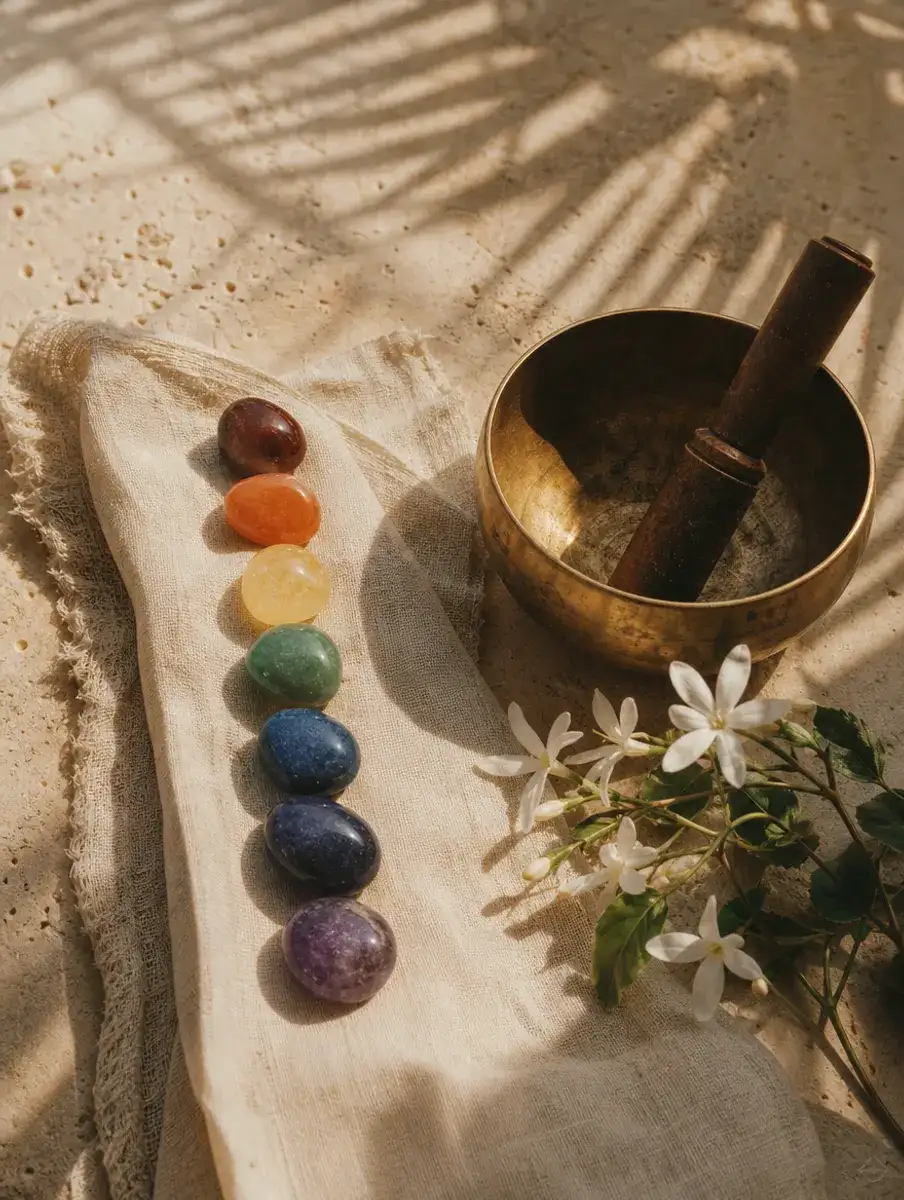
Chakra is a Sanskrit word for wheel, used in later tantric and hatha yoga texts for points along the spine that the texts describe as centres in a subtle body. The familiar list of seven chakras, from the base of the spine to the crown of the head, comes mainly from one sixteenth-century text and its twentieth-century English translation.
This page describes the chakras as a system of ideas: what the texts say, and how the picture changed over time. It makes no claim that chakras exist physically or that any practice acts on them.
Where the names come up in a Yin yoga class, they are only a place to rest your attention.
The word
Chakra (cakra) means wheel or circle. In early Indian texts it can mean a chariot wheel, a discus or a circle of people. The sense of a centre in the body comes later.
Where the system comes from
The chakras belong to tantra, a broad family of Hindu and Buddhist traditions that grew over many centuries, and to the hatha yoga texts that drew on them. These texts describe a subtle body, a map of channels (nadis) and centres, which the practitioner is taught to visualise in meditation. An older Upanishadic map, the five koshas, layers of the self, describes the person as sheaths rather than centres.
There was never one agreed map. Different tantric texts describe different numbers of centres: some four, some five or six, some many more, placed in different spots and given different names.
Buddhist tantra has its own versions.
The seven-centre list that is standard today was shaped largely by the Sat-cakra-nirupana, a text usually dated to the sixteenth century.
In 1919 it was translated into English by Sir John Woodroffe, writing as Arthur Avalon, in a book called The Serpent Power. That translation became the main source for how the chakras were understood outside India.
The seven chakras as the texts describe them
In this system, six centres lie along the spine and a seventh sits above the head:
- Muladhara, at the base of the spine, explained on the page about the root chakra.
- Svadhisthana, in the pelvis, the centre now called the sacral chakra.
- Manipura, at the navel, known in English as the solar plexus chakra.
- Anahata, at the heart, described on the page about the heart chakra.
- Vishuddha, at the throat; see the throat chakra.
- Ajna, between the eyebrows, the centre often called the third eye.
- Sahasrara, at or above the crown of the head, described as a lotus of a thousand petals and often treated as separate from the other six; see the crown chakra.
The texts describe each centre as a lotus, the flower of Hindu and Buddhist symbolism, with a set number of petals, with its own Sanskrit syllables, element, shape and presiding deity. In kundalini practice, as the texts present it, a force pictured as a coiled serpent at the base of the spine rises through these centres toward the crown.
A chakra chart from the traditional texts
The table follows the six centres and the crown as the Sat-cakra-nirupana describes them, in the form most often cited from Woodroffe’s translation. Details such as petal counts are consistent across most later sources; colours are not, so they are left out here. The rainbow sequence seen on posters is a modern addition.
| Chakra | Placed at | Petals | Element | Shape of the element | Bija syllable |
|---|---|---|---|---|---|
| Muladhara | Base of the spine | 4 | Earth | Square | Lam |
| Svadhisthana | Pelvis, above the base | 6 | Water | Crescent moon | Vam |
| Manipura | Navel | 10 | Fire | Triangle | Ram |
| Anahata | Heart | 12 | Air | Six-pointed star | Yam |
| Vishuddha | Throat | 16 | Space (akasha) | Circle | Ham |
| Ajna | Between the eyebrows | 2 | Mind, beyond the elements | None of the five | Om |
| Sahasrara | Crown, or above it | 1,000 | Beyond the elements | None | None in most accounts |
Is there scientific evidence for chakras?
No. Anatomy has not found structures that match the chakras, and the texts did not describe them as physical organs in the first place. They describe a map for visualisation in meditation. Reading the chakras that way, as a traditional meditative map, keeps them in their own context without asking them to do the work of medicine.
A short attention practice using the chakra names
This uses the map as the texts did, as places to rest attention. It makes no claim about what happens in the body.
- Sit comfortably with a long spine and close the eyes.
- Rest attention at the base of the spine for three breaths. If you like, say the syllable lam silently.
- Move up one place at a time: the pelvis (vam), the navel (ram), the heart (yam), the throat (ham), between the eyebrows (om), three breaths at each.
- Rest attention at the crown for three breaths with no syllable.
- Let the map go and sit for a minute, simply breathing.
The whole practice takes about five minutes and suits the quiet end of a class or a calm moment at home.
How modern yoga culture changed the picture
During the twentieth century, writers in Europe and the United States added layers the Sanskrit texts do not contain. The rainbow colour sequence, the pairing of each chakra with an endocrine gland, and the matching of chakras to emotions or personality traits are all modern additions. So are most of the claims about blocked or unbalanced chakras.
Scholars of tantra generally treat this later material as a new, Western development rather than a continuation of the older texts.
Knowing that history makes it easier to read modern chakra content for what it is: a recent reinterpretation, not a description found in the old sources.
How chakras can come up in a class
If you are curious about the history, a teacher may be happy to talk about it or suggest where to read further.
In the practice itself, the names can sometimes serve as simple places to rest your attention, such as the throat during a humming breath or the spine during a slow twist. That is a way of focusing, not a claim about what happens in the body.
A slow, quiet practice such as Yin leaves time for these conversations. The Sanskrit yoga glossary explains the other terms on this page.
What does chakra mean outside the subtle body?
Chakra meaning is broader than the seven centres. The Sanskrit word cakra simply means wheel, and it carries that sense across many parts of Indian culture.
In Buddhism, the dharmachakra, the wheel of the teaching, is one of the oldest symbols, and the Buddha’s first sermon is traditionally described as setting that wheel in motion. A spoked wheel of this kind, the Ashoka Chakra, sits at the centre of the flag of India. In Hindu stories, the Sudarshana Chakra is the spinning discus carried by Vishnu. Older texts also speak of the chakravartin, a wheel-turning ruler whose chariot wheels roll on without obstruction.
The use of chakra for centres in the body grows out of the same image: a wheel, or a circle of petals, at a point along the spine. Buddhist tantric texts describe their own sets of wheels, often four or five rather than seven. So when you meet the word in a yoga class, it helps to know it is an ordinary Sanskrit word with a long life outside the body map.
Chakras are often drawn as part of larger diagrams; see what a mandala is for how those images are used.
This page feeds the Sanskrit flashcard deck.
Browse all yoga philosophy pages.
Sources: Mayo Clinic, Fitness program: 5 steps to get started; NCCIH (US National Institutes of Health), Yoga: Effectiveness and Safety. Last reviewed 2 October 2026.
Questions
What are the 7 chakras?
In the modern seven-chakra system they are muladhara (base of the spine), svadhisthana (pelvis), manipura (navel), anahata (heart), vishuddha (throat), ajna (between the eyebrows) and sahasrara (crown of the head). Older texts count them differently.
Where do chakra colours come from?
The rainbow sequence, red at the base to violet at the crown, is a twentieth-century Western addition. The older Sanskrit descriptions assign each centre its own colours, shapes, syllables and deities, and they do not follow a rainbow.
Are chakras part of classical yoga?
Not of Patanjali's Yoga Sutras, which do not set out a chakra system. Chakras belong to later tantric and hatha yoga texts, and the system varies a great deal between them.
How many chakras are there?
It depends on the text. Different tantric traditions list four, five, six or more centres. The familiar seven, six along the spine plus the crown, comes mainly from the sixteenth-century Sat-cakra-nirupana, which reached English readers through Arthur Avalon's translation in The Serpent Power in 1919, and became the standard list in modern yoga.
What is a bija mantra?
A bija, or seed, mantra is a single syllable that the tantric texts link to each chakra. In the common seven-chakra system they are lam for Muladhara, vam for Svadhisthana, ram for Manipura, yam for Anahata, ham for Vishuddha and om for Ajna, while the crown is usually left without one. They are chanted as part of traditional chakra meditation.
What do the seven chakras represent?
In the tantric and hatha texts, the seven chakras are centres in a subtle body, pictured as lotuses along the spine from its base to the crown, each with its own petals, element and syllable. They are a map for visualisation in meditation, not physical organs. Links to glands, colours and emotions are modern additions.
Keep reading
Your yoga calendar
We track every yoga event, workshop and pop-up class so you don't have to.
Updated