Philosophy · reviewed by a teacher
Om: the syllable, the symbol and the chant
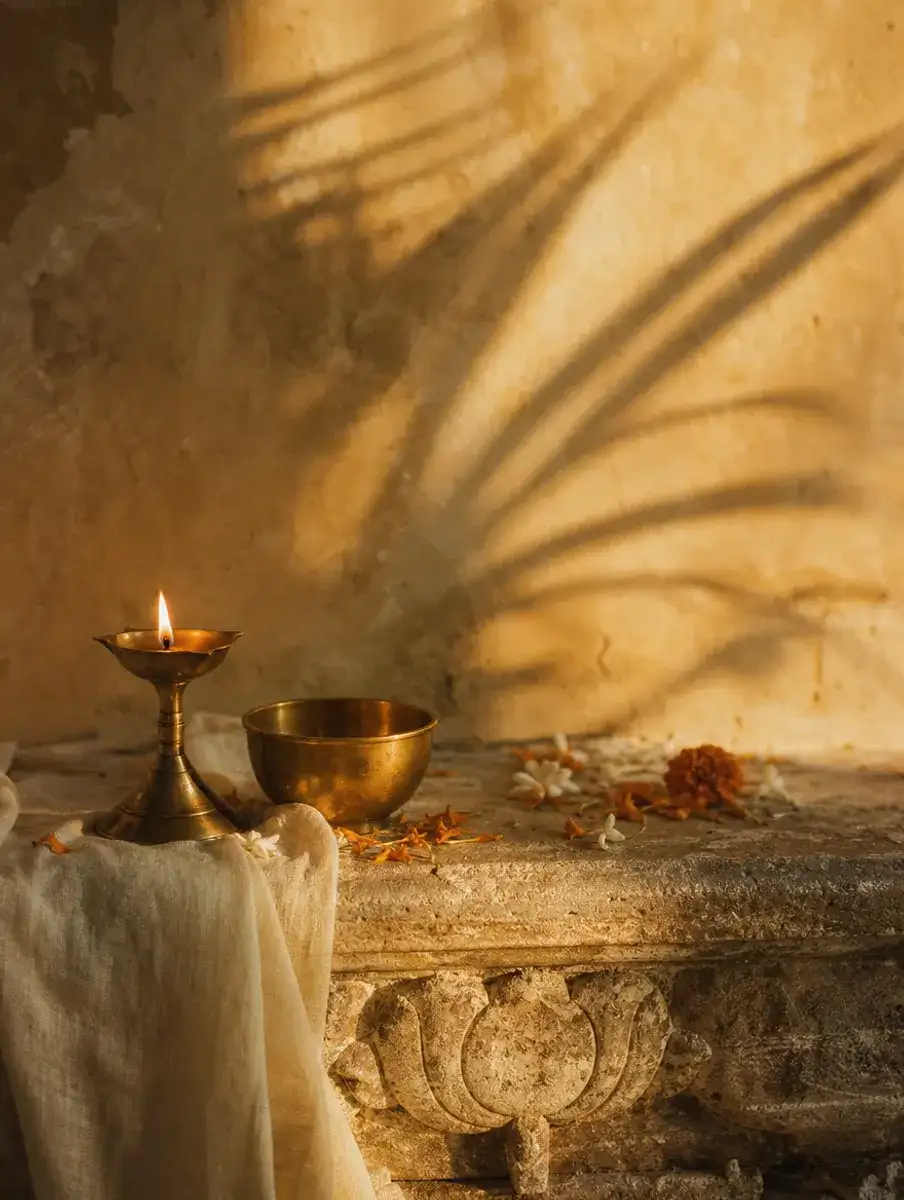
Om is a Sanskrit syllable, also written aum, treated with deep reverence in Hinduism, Buddhism and Jainism. It is chanted at the start and end of prayers, readings and yoga practice. In yoga philosophy it is described as the sound that expresses the whole of reality, and its written symbol is ॐ.
What is om?
Om is a single syllable, but it is often described as three sounds and a silence. In Sanskrit, a and u blend into a long o, so om can also be written aum. Chanted slowly, it moves from an open “ah” through a rounded “oo” to a closed, humming “mm”, and then stops. That long hum is close kin to the sustained tones of a sound bath.
The written symbol, a curved character with a small crescent and dot above it, is one of the most recognisable signs in South Asia. You will see it on temple doors, in homes, at the head of letters and on book covers.
What the Om symbol means
The Om symbol, ॐ, is the syllable written in Devanagari, the script used for Sanskrit and Hindi. The crescent and dot above it are a real feature of the script, a mark called chandrabindu that shows the sound is nasal, the humming “m”. Other scripts write om in their own shapes, so the Tamil, Tibetan and Bengali forms all look different.
A widely repeated reading gives each part of the symbol a meaning drawn from the Mandukya Upanishad: the three curves stand for waking, dreaming and deep sleep, the dot for the fourth state beyond them, and the crescent for the veil that separates them. It is a later teaching device rather than something the Upanishad itself says about the written shape, but it is a helpful way to remember what the sound is said to contain.
Where it comes from
Om appears in the Vedas, the oldest Sanskrit texts, where it came to be chanted at the start and end of recitation. It is discussed at length in the Upanishads, the philosophical texts that follow them, where it stands for brahman, the ultimate reality. The Mandukya Upanishad, one of the shortest, is devoted almost entirely to om. It reads the three sounds as three states of consciousness, waking, dreaming and deep sleep, and the silence after them as a fourth state beyond all three.
In Patanjali’s Yoga Sutras, om, called pranava, is the word that expresses Ishvara, and the text suggests repeating it while reflecting on its meaning. The Bhagavad Gita also gives om a central place. Later, the tantric chakra texts made om the seed syllable of ajna, between the eyebrows, the centre just below the crown chakra, sahasrara.
Om is not only Hindu. It is chanted in Buddhist mantras, for example at the start of om mani padme hum, the Tibetan mantra of compassion, and it holds an important place in Jain practice. Sikhism’s opening phrase, Ik Onkar, is related. Each tradition understands it in its own way, and the syllable deserves the same respect in a yoga room that it receives in a temple.
How do different traditions understand om?
The syllable is shared, but the reading differs. This short table is a starting point, not a full account.
| Tradition | Where om appears | How it is usually understood |
|---|---|---|
| Hindu | Vedic recitation, the Upanishads, the Yoga Sutras, daily prayer | The sound of brahman; the three sounds as waking, dreaming and deep sleep |
| Buddhist | The opening of many mantras, especially in Tibetan practice | A revered opening sound rather than a name for an ultimate reality |
| Jain | Prayer and the Namokar mantra tradition | Often explained as built from the first sounds of the five revered beings honoured in that mantra |
| Sikh | Ik Onkar, the first words of the Guru Granth Sahib | One creator; the phrase is related to om but carries Sikh meaning |
What do people often get wrong about om?
That it is just a relaxation sound. For many people it is a prayer. Using it in a class is fine, but it is not a neutral noise.
That it must be chanted loudly or at a set pitch. Texts and teachers differ, and a quiet or silent om is a recognised practice too.
That om and Om Shanti are the same thing. Om Shanti adds the word for peace, usually repeated three times, as a closing.
That the symbol is decoration. It is a written religious character, which is why the care described above matters.
A short om practice for a busy morning
If you practise before work, perhaps in a quiet room before the commute, three rounds take about a minute.
- Sit on the edge of the bed or a chair with both feet on the floor.
- Take two ordinary breaths to settle.
- Chant om three times, letting the hum take most of each out-breath.
- Sit for three quiet breaths after the last one before you stand.
How it shows up in a modern practice
In many yoga classes, om is chanted once or three times at the beginning and the end. The teacher leads and the room joins in. It gives a clear start and a clear finish, it brings everyone’s breath to the same pace for a moment, and the long hum of the “mm” is a simple way to settle. Teachers who use chakra language sometimes direct that hum to the throat, the place of vishuddha, the throat chakra.
Some classes skip it entirely, out of respect for students of other faiths or simply as a matter of style. Others chant longer mantras that begin with om, such as the Gayatri mantra, a verse from the Rig Veda, or om namah shivaya, the five-syllable mantra to Shiva. Both approaches are common.
How do you chant om?
- Sit comfortably. A cross-legged seat on a folded blanket or a chair both work. Let the hands rest on the thighs.
- Breathe in fully through the nose, without straining.
- Open with “ah”. Start the sound with the mouth open, low and relaxed.
- Round to “oo”. Let the lips draw in as the sound moves forward in the mouth.
- Close to “mm”. Bring the lips together and let the hum carry most of the out-breath.
- Rest in the silence. When the breath runs out, sit quietly for a moment before the next round, or before you begin.
There is no right pitch. In a group, it is fine to follow the teacher’s note or simply hum along.
Chanting om on your own terms
A one-to-one lesson or a home practice has no room of voices to join, so chanting is entirely your choice. If you would like to try it, om can be chanted at the start or the end, or you can listen and join only when you feel ready. If you would rather not, the practice can begin and end with a few quiet breaths instead.
If you are new to classes, your first yoga class explains what usually happens at the start and the end.
Is the aum symbol different from the om symbol?
No. Aum and om are two spellings of the same syllable, and the aum symbol is the same written sign, ॐ. The spelling aum is popular because it shows the three sounds, a, u and m, that the Mandukya Upanishad describes, while om shows how the syllable is usually said aloud. You will see both on mats, prints and jewellery, and both refer to the same character.
When you see the sign in a yoga room, it is usually there as a reminder of the chant at the start and end of class. It is also a religious symbol for many Hindus, Buddhists and Jains, so it is worth treating with care. Many teachers suggest keeping it off the floor and away from the feet, which is why some practitioners choose not to have it printed on a yoga mat. If you are thinking of using it on clothing or as a tattoo, it helps to learn what it means first, and to remember that many people will see it as a sign of faith rather than a design.
This page feeds the meditation bell timer and the flashcards for Sanskrit terms.
Browse the yoga philosophy library.
Sources: Mayo Clinic, Fitness program: 5 steps to get started; NCCIH (US National Institutes of Health), Yoga: Effectiveness and Safety. Last reviewed 2 October 2026.
Questions
What is om in simple words?
A single syllable, said or sung as a long hum, that Hindu, Buddhist and Jain traditions use to open and close prayer and practice. In yoga it is the sound many classes chant once or three times at the beginning or the end.
How many times do you chant om?
There is no fixed rule. Many classes chant it once or three times. In mantra practice it may be repeated many more times, sometimes counted on a mala, a string of 108 beads.
What does om mean in yoga?
In the Yoga Sutras, om is the word that expresses Ishvara, often translated as God or the supreme teacher, and repeating it while reflecting on its meaning is offered as a practice. In a modern class it most often marks the beginning or end of practice.
Is it om or aum?
Both. In Sanskrit the vowel sounds a and u combine to make a long o, so the syllable is written om but can be heard as three parts, a, u and m. Many teachers chant it with those three parts in mind.
Do you have to chant om in a yoga class?
No. You can listen, hum quietly, or sit in silence. None of them is disrespectful.
Does om have a literal translation?
Not in the way ordinary words do. Om is a syllable rather than a word with a dictionary meaning. The Upanishads describe it as a sound that stands for brahman, the whole of reality, and the Mandukya Upanishad links its three sounds, A, U and M, to waking, dreaming and deep sleep, with the silence afterwards pointing to a fourth state beyond them.
What is om called in Sanskrit texts?
Om is often called pranava in Sanskrit, a name usually explained as the sound that hums or resounds. The Yoga Sutras of Patanjali use this term and describe the pranava as the word that expresses Ishvara. You may also hear it called omkara, the syllable om, especially in chanting and in Hindu temple settings.
Is chanting om religious?
Om is held in deep reverence in Hinduism, Buddhism and Jainism, so for many people it is a religious sound. In most yoga classes it is offered as a shared sound to mark the start or end of practice, and nobody checks what you believe. You are free to chant, to hum along quietly or to sit in silence while others chant.
Your yoga calendar
We track every yoga event, workshop and pop-up class so you don't have to.
Updated