Philosophy · reviewed by a teacher
Om mani padme hum
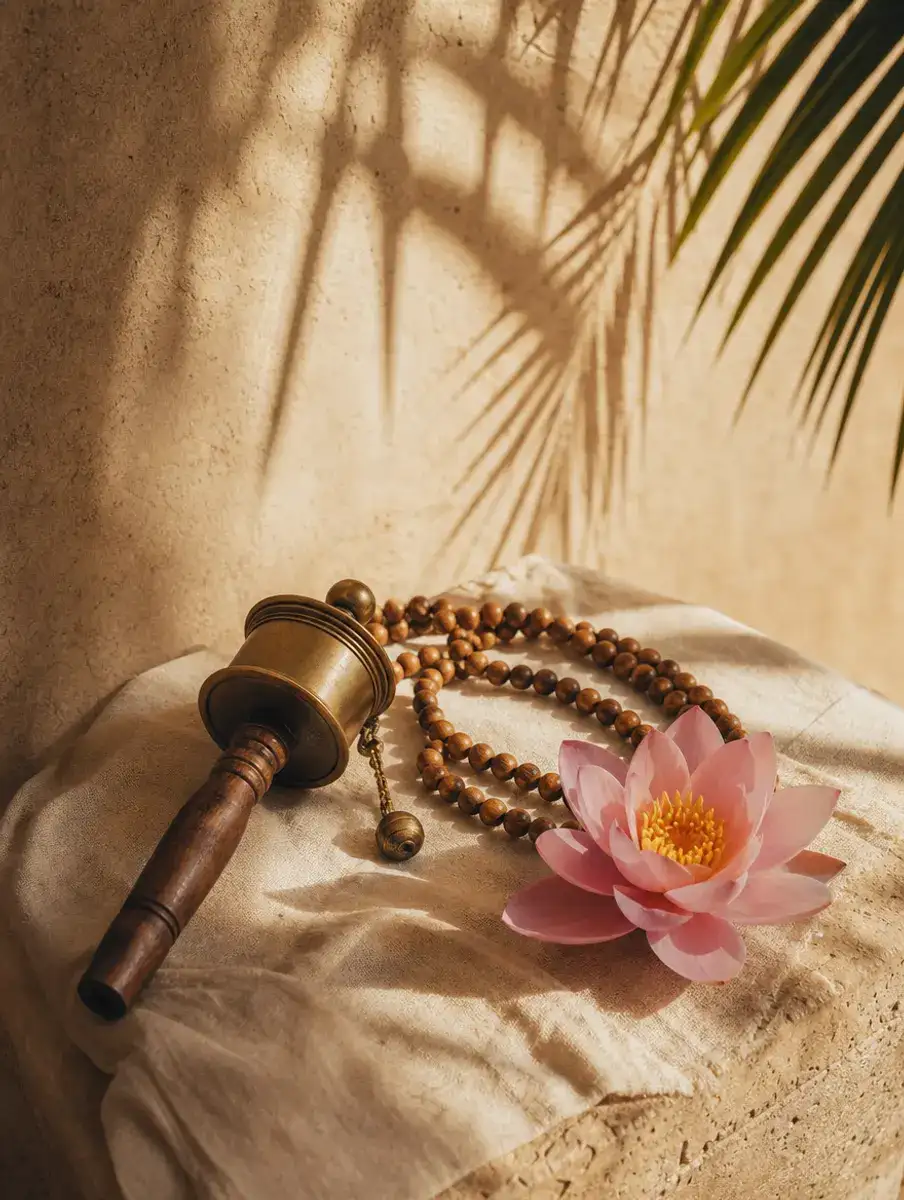
Om mani padme hum is a Buddhist mantra, the six-syllable mantra of Avalokiteshvara, the bodhisattva of compassion, and the most widely recited mantra in Tibetan Buddhism. Mani means jewel and padme refers to the lotus, so it is often glossed as the jewel in the lotus, though scholars read the grammar in more than one way.
The mantra
Om mani padme hum is six syllables: om, ma, ni, pad, me, hum. It is a Buddhist mantra, not a Hindu one, and in Tibet, Nepal, Bhutan and the Himalayan regions of India it is everywhere: murmured on the street, carved into stones, painted on cliffs and printed thousands of times on paper rolled inside prayer wheels.
It belongs to Avalokiteshvara, the bodhisattva of compassion, known in Tibetan as Chenrezig. A bodhisattva, in Mahayana Buddhism, is one who delays their own final liberation to help all beings, and the mantra is recited as a way of calling on and cultivating that compassion.
A yoga class is not a Buddhist ceremony. Still, if the mantra matters to you, the quiet minutes of final rest, or of a sound bath with singing bowls, are a time when you can repeat it silently.
What the words mean
Om is the syllable that opens many mantras across Indian traditions. Its wider history is on the page about the meaning of om. Mani means jewel. Padme is a form of padma, lotus. Hum is a seed syllable, a sound with no dictionary meaning that is used to close or seal many Buddhist mantras.
The popular gloss, “the jewel in the lotus”, was spread by nineteenth-century European translators, who read padme as “in the lotus”. Many scholars now think the middle words more likely address a figure called Manipadma, “the one with the jewel and lotus”, which fits the way Avalokiteshvara is shown holding both. Tibetan teachers rarely translate it word for word at all. They treat each syllable as carrying meaning of its own. The jewel and the lotus are central Buddhist images, and the meaning of the lotus flower has its own page.
Where it comes from
The mantra first appears in a Mahayana text called the Karandavyuha Sutra, usually dated to around the fourth or fifth century CE, which praises Avalokiteshvara and teaches the six syllables. From India it spread to Tibet, where it became the most widely recited mantra of all.
Tibetan teachers often link the six syllables to six qualities to be cultivated, generosity, ethics, patience, effort, concentration and wisdom, or to the six realms of rebirth that compassion reaches. The Fourteenth Dalai Lama has taught that the mantra expresses the union of method and wisdom, through which an ordinary mind can be transformed.
How it is practised
Most people recite it as japa, steady repetition, often counted on a mala of 108 beads, a number with meaning across Indian traditions. Prayer wheels hold the mantra written many times, and turning the wheel clockwise is understood as a way of reciting it. Mani stones, flat stones carved with the six syllables, are piled into long walls along Himalayan paths, and travellers walk past them keeping the stones on their right. Prayer flags printed with the mantra are hung to move in the wind.
For a broader picture of repeated sounds in Indian traditions, see the page on what a mantra is.
How it can come up in a yoga class
This mantra belongs to a living Buddhist practice, so it should never be background decoration in a class. If you practise it already, the closing rest is a natural time to repeat it quietly. If you are simply curious, learning where it comes from, as above, is a good first step, and a teacher who uses it in class should be able to explain its source.
For a simple seated practice to pair it with, see a simple guide to sitting meditation.
Browse all yoga philosophy pages.
Sources: Mayo Clinic, Fitness program: 5 steps to get started; NCCIH (US National Institutes of Health), Yoga: Effectiveness and Safety. Last reviewed 2 October 2026.
Questions
Is om mani padme hum Hindu or Buddhist?
Buddhist. It comes from Mahayana Buddhist scripture and is above all the mantra of Tibetan Buddhism. It begins with om, a syllable that Hindu, Buddhist and Jain traditions all use, which is why it is sometimes assumed to be Hindu.
How do you pronounce om mani padme hum?
In Sanskrit it is om ma-ni pad-me hum. Many Tibetans say om mani peme hung, and both are correct in their own setting.
Can anyone chant om mani padme hum?
Tibetan teachers generally encourage anyone to recite it, and it is chanted openly in public places. It is still a living religious practice, so it is worth learning what it means and treating it with the respect you would give a prayer.
What happens when you chant om mani padme hum?
In Tibetan Buddhism, reciting the six syllables is a way of calling on Avalokiteshvara, the bodhisattva of compassion, and of cultivating that compassion in yourself. Teachers often link each syllable to a quality such as generosity, patience or wisdom. Most people recite it as steady repetition on a mala, and the practice is to keep returning to the sound.
Your yoga calendar
We track every yoga event, workshop and pop-up class so you don't have to.
Updated