Philosophy
The Upanishads
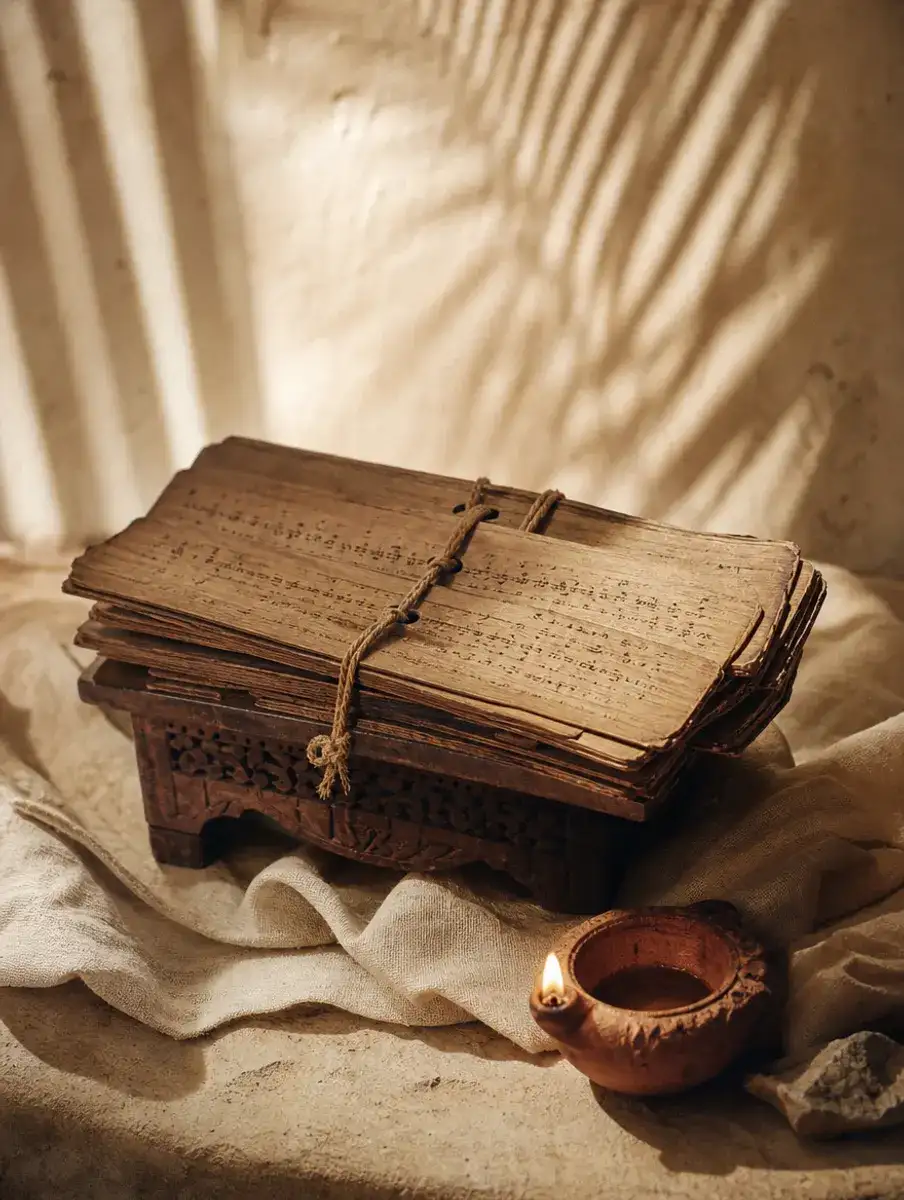
The Upanishads are a group of Sanskrit philosophical texts that close the Vedas, composed over many centuries from roughly the seventh century BCE. They ask what the self is and how it relates to brahman, the ground of all things. They also contain the first clear descriptions of yoga as a practice of steadying the senses.
The Upanishads are the philosophical texts that come at the end of the Vedas, the oldest scriptures of Hinduism. They were composed over many centuries, starting around the seventh century BCE, and they ask the questions that much of later Indian philosophy, including yoga, set out to answer.
Because they close the Vedas, they are also called Vedanta, the end of the Veda, which became the name of the schools that built on them.
What does the word Upanishad mean?
Upanishad joins upa, near, ni, down, and shad, to sit. It is usually explained as sitting down near a teacher to receive instruction, which fits the many dialogues between teachers and students in the texts. Some scholars read it instead as a hidden connection or secret teaching. Both senses suit the texts, and the page on the meaning of guru looks at the teacher’s role more closely.
When were the Upanishads written?
The oldest, the Brihadaranyaka and Chandogya, are in prose and are usually dated to around the seventh and sixth centuries BCE, before the time of the Buddha. A middle group, including the Katha, Isha, Mundaka and Shvetashvatara, is in verse and later. A large number of minor Upanishads came much later still, including a set of medieval Yoga Upanishads on breath, sound and meditation, written when tantra, with its mantras and subtle body, was shaping yoga practice.
The texts were passed down orally long before they were written. They reached Europe through a Persian translation commissioned by the Mughal prince Dara Shikoh in 1657, which was then put into Latin around 1801.
What do the Upanishads teach?
Their central theme is the relationship between atman, the inner self, and brahman, the reality underlying everything. The Chandogya Upanishad states it in three words, tat tvam asi, “that you are”. The Taittiriya Upanishad maps the person as five koshas, sheaths around the self. Knowing this unity, the texts say, frees a person from the cycle of rebirth, the goal called moksha, liberation.
Many ideas that later shaped yoga first appear here: prana, breath as the life of the body, karma and samsara, the cycle of rebirth, and Om as the sound of the whole, which the short Mandukya Upanishad explains syllable by syllable. The Shvetashvatara Upanishad also speaks of maya, the power of appearance, an idea that grew in later Vedanta and is explained on the page about maya and illusion.
Buddhist and Jain teachers were working in the same centuries and argued with Upanishadic ideas, especially about the self. The Buddha’s teaching of no permanent self is in part a reply to them, and his goal of nirvana, the end of craving, is set against their idea of a freed self.
What are the ten principal Upanishads?
The classical list of ten comes from the texts the philosopher Shankara commented on. Each belongs to one of the four Vedas.
| Upanishad | Veda | Known for |
|---|---|---|
| Isha | Shukla Yajurveda | Eighteen verses on seeing the divine in everything |
| Kena | Samaveda | The question of what moves the mind and senses |
| Katha | Krishna Yajurveda | The boy Nachiketa questioning Death; the chariot image |
| Prashna | Atharvaveda | Six students asking six questions, including about prana |
| Mundaka | Atharvaveda | Higher and lower knowledge; two birds on one tree |
| Mandukya | Atharvaveda | Om and the four states of consciousness, in twelve verses |
| Taittiriya | Krishna Yajurveda | The five koshas |
| Aitareya | Rigveda | Creation and the self as consciousness |
| Chandogya | Samaveda | Tat tvam asi; Uddalaka teaching Shvetaketu |
| Brihadaranyaka | Shukla Yajurveda | The longest and among the oldest; Yajnavalkya’s dialogues |
What are the four great sayings?
Later Vedanta picked out one short statement, a mahavakya, from an Upanishad attached to each of the four Vedas:
- Prajnanam brahma, consciousness is brahman (Aitareya, Rigveda).
- Aham brahmasmi, the same identity spoken in the first person: the one speaking is brahman (Brihadaranyaka, Yajurveda).
- Tat tvam asi, that you are (Chandogya, Samaveda).
- Ayam atma brahma, this self is brahman (Mandukya, Atharvaveda).
Each says the same thing from a different angle: the inner self and the whole are not two.
How have the Upanishads travelled beyond India?
After the Persian and Latin translations, the German philosopher Arthur Schopenhauer read them closely and wrote of their importance to him. In the United States, Ralph Waldo Emerson and Henry David Thoreau drew on Indian texts in their own writing, and in 1937 the Irish poet W. B. Yeats published a translation of ten Upanishads with Shree Purohit Swami. Today many readers meet them first through yoga classes and teacher trainings.
A reading order for beginners
- Isha, one sitting, to get a feel for the style.
- Kena, for its short, puzzling questions.
- Katha, the most story-like and the one that names yoga.
- Mandukya, alongside a commentary, to understand Om.
- Then a selection from the Chandogya and Brihadaranyaka.
Where does yoga appear in the Upanishads?
The Katha Upanishad compares the body to a chariot, the senses to horses and the mind to the reins, and calls yoga the firm holding of the senses. The Shvetashvatara Upanishad describes sitting with the body upright in a clean, quiet place and steadying the breath. These passages are the bridge between the Vedas and the systematic yoga of Patanjali, as the long view of yoga’s history sets out.
How do the Upanishads show up in a modern yoga class?
Mostly through chants. The closing om shanti shanti shanti is attached to many Upanishads as their peace invocation. The chant asato ma sad gamaya, lead me from the unreal to the real, from darkness to light, from death to immortality, comes from the Brihadaranyaka. The shorter om shanti om, peace framed by om, is a modern form built from the same words. And the Om that opens a class carries the meaning the Mandukya gives it.
Reading a short Upanishad with a good translation is a sensible next step if a class has made you curious about the ideas behind the practice, especially jnana yoga, the path of knowledge.
Browse all yoga philosophy pages.
Sources: Mayo Clinic, Fitness program: 5 steps to get started; NCCIH (US National Institutes of Health), Yoga: Effectiveness and Safety. Last reviewed 2 October 2026.
Questions
How many Upanishads are there?
Over two hundred texts carry the name, but a late text called the Muktika Upanishad lists a canon of 108. Scholars usually single out about ten to thirteen as the principal Upanishads, because they are the oldest and the ones the major commentators wrote on.
Which Upanishad should a beginner read first?
The Isha and Katha Upanishads are short and often recommended. The Katha tells the story of a boy, Nachiketa, who questions Yama, the lord of death, and it includes one of the earliest definitions of yoga.
What does tat tvam asi mean?
Tat tvam asi means "that you are". In the Chandogya Upanishad a father repeats it to his son to teach that the inner self is one with the reality behind the whole world. It is one of the best-known short sayings of Vedanta.
Who wrote the Upanishads?
Most Upanishads have no known author. They grew out of teachings passed on by word of mouth over many generations, and were written down much later. Some teachers are named inside the texts, such as Yajnavalkya and Uddalaka Aruni, who appear in dialogues with students, kings and their own families.
What are the main Upanishads?
About ten to thirteen are usually called the principal Upanishads. The ten that the philosopher Shankara wrote commentaries on are the Isha, Kena, Katha, Prashna, Mundaka, Mandukya, Taittiriya, Aitareya, Chandogya and Brihadaranyaka. The Shvetashvatara is often added, and it is one of the texts that describes yoga practice.
What is the difference between the Vedas and the Upanishads?
The Upanishads are part of the Vedas, their final layer. The earlier parts of the Vedas are mostly hymns and instructions for ritual, while the Upanishads turn to philosophical questions about the self and reality. That is why they are also called Vedanta, the end of the Vedas.
Keep reading
Your yoga calendar
We track every yoga event, workshop and pop-up class so you don't have to.
Updated