Philosophy · reviewed by a teacher
Namaste: the greeting, word by word
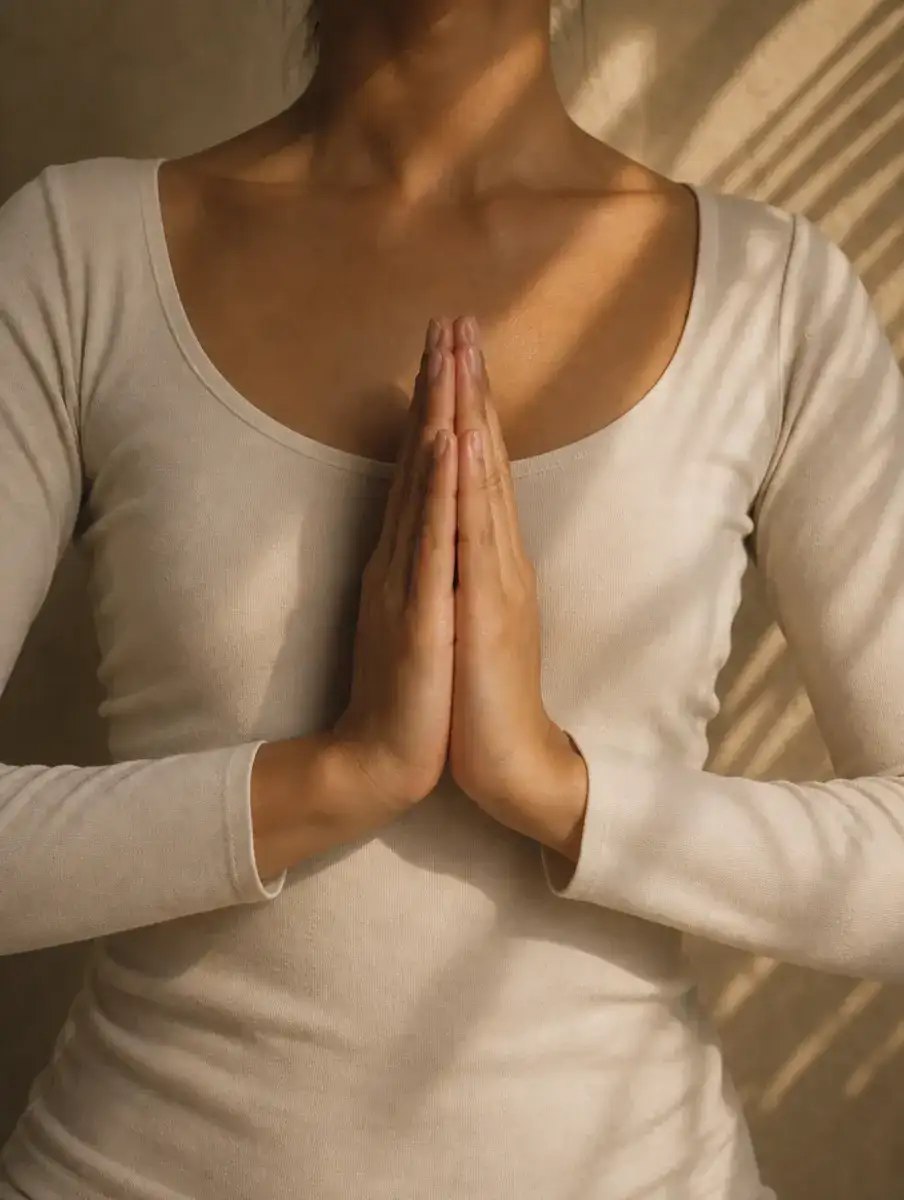
Namaste is a respectful Sanskrit greeting that means "I bow to you", from namah (a bow or salutation) and te (to you). It is said with the palms pressed together at the chest and a small bow of the head, and it works as both hello and goodbye across India and Nepal.
Basahin sa Filipino: ang paliwanag sa Tagalog
Teacher's note from Joahnna Lee
“The literal meaning is simpler, and I think it is better for being simple: I bow to you.”
What is namaste?
Namaste joins two Sanskrit words. Namah (it becomes namas before certain sounds) means a bow, a salutation, a gesture of respect. Te means to you. Put together, it is a bow offered to the person in front of you, and at the end of a slow Yin yoga practice it is often the last word said.
A more formal version, namaskar or namaskara, is also common. Both are greetings, not prayers, and both work as hello and as goodbye.
Where it comes from
The root word namah is very old. It appears again and again in early Sanskrit hymns and prayers, where it is used to offer respect, often to a deity. It still sits inside many chants, as in om namah shivaya, a mantra repeated as a focus of devotion. Over time the same word settled into ordinary speech as a way of greeting people.
Today namaste is an everyday greeting across India and Nepal, in Hindi, Nepali and other languages. You say it to an elder, a shopkeeper, a guest at the door. It is polite rather than religious, much as “good morning” is.
The gesture that goes with it has its own name: anjali mudra, the palms pressed together in front of the chest. Anjali means an offering made with the hands. Often the gesture is enough and the word is left unsaid.
How do you do namaste?
- Bring the palms together in front of the chest, fingers pointing up, in anjali mudra.
- Let the thumbs rest lightly near the breastbone, elbows relaxed.
- Bow the head a little, a small nod rather than a deep bend.
- Say namaste softly if you wish, or let the gesture speak for you.
In India and Nepal the same gesture is used for hello and goodbye, and for a more formal greeting some people raise the hands toward the forehead.
What the popular translations get right and wrong
Many yoga studios print a longer version on the wall, something like “the light in me honours the light in you”. That line is a modern reading. It points at a real idea, respect for the person in front of you, but it is not what the word says. The literal meaning is simpler, and arguably better for being simple: “I bow to you”.
Are there greetings like namaste in other cultures?
Pressing the palms together, or bowing as a greeting, appears across much of Asia. The gestures look alike but each has its own rules.
| Greeting | Where | What happens |
|---|---|---|
| Namaste or namaskar | India, Nepal | Palms together at the chest, a small nod |
| Vanakkam | Tamil-speaking regions of India and Sri Lanka | The same gesture with a Tamil word |
| Wai | Thailand | Palms together, with the height of the hands and depth of the bow showing the level of respect |
| Sampeah | Cambodia | Palms together, raised higher for elders and monks |
| Gassho | Japan, in Buddhist settings | Palms together at the chest before a bow |
| Mano po | Philippines | Not a palms-together gesture: a younger person takes an elder’s hand and touches it to the forehead |
For a Filipino student, mano po may be the closest everyday comparison. Both are small, physical signs of respect, and both are about the person in front of you rather than about religion.
How can you use namaste respectfully?
- Know what it means. A plain “I bow to you” is enough.
- Match the setting. At the end of a class, follow the teacher. In daily life outside South Asia, a spoken thank you often fits better.
- Keep it a greeting. Namaste on a coffee mug or as a pun on a T-shirt makes some people uncomfortable, because the word is part of daily life for many Hindus and Nepalis.
- Do not correct people who skip it. A student who stays quiet at the end of class is not being rude.
How do Indians and Nepalis use it day to day?
In India and Nepal, namaste is often said to elders, teachers and guests, and the hands may rise higher for someone very senior. Between close friends of the same age, many people use a casual hello instead. The gesture also works without words, across a noisy street or a crowded room.
How it shows up in a modern practice
In most yoga classes outside India, namaste arrives at the very end. The teacher sits up after the final rest, brings the palms together and bows, and the room answers. In some classes the bow follows a chant of om shanti, a wish for peace said three times. It became a common closing as yoga spread to studios abroad. Namaste, om and shanti are among the words in the class deck of our Sanskrit flashcards, if you want to learn the rest of what a teacher says.
In practice it does a few useful things. It marks the end of the practice so you do not jump straight from rest to your phone. It gives the teacher and the student a moment to thank each other. And the hands at the chest are a small, steady shape to come back to.
Anjali mudra also turns up in the postures themselves. The hands come together at the start of a Sun Salutation, in some twists, and in balancing shapes like Tree Pose.
Namaste in a small or one-to-one class
A one-to-one lesson or a very small class has no room full of people answering in unison, so there is nothing to keep up with. If the gesture comes up at the end, it is an offer, not an instruction. Whether you say namaste, thank you, or nothing at all is up to you, and none of them is wrong.
If you are heading to your first group class, what to expect in your first yoga class covers the rest of the etiquette.
This page is one of the sources behind the Sanskrit flashcards.
Browse every philosophy guide.
Sources: Mayo Clinic, Fitness program: 5 steps to get started; NCCIH (US National Institutes of Health), Yoga: Effectiveness and Safety. Last reviewed 2 October 2026.
Questions
How do you pronounce namaste?
In three syllables, na-mas-te, with short, soft a sounds like the a in about and a final e close to the ay in day. Many English speakers say nah-muh-stay, and it is understood everywhere.
When do people say namaste in India?
When meeting or leaving someone, especially an elder, a guest or anyone you want to show respect to. It is common at the door, at the start of a meeting and in shops, and the gesture on its own, without the word, is often enough.
What does namaste literally mean?
Literally, "a bow to you" or "I bow to you". Namah means a bow or a salutation, and te means to you. Everything beyond that, including the popular "the light in me honours the light in you", is a later interpretation rather than a translation.
Is it disrespectful to say namaste at the end of a yoga class?
Said sincerely, it is a greeting of respect, and that is how it is used. What people sometimes object to is the word used as a slogan or a joke. If you would rather not say it, a quiet bow or a simple thank you carries the same meaning.
Do you have to say namaste back to the teacher?
No. Nobody should expect it. You can bring your palms together, nod, say thank you, or simply stay where you are. All of them are fine.
What is the difference between namaste and namaskar?
Both come from namah, a bow or salutation, and both are used as a respectful greeting with the palms together. Namaste adds te, to you, while namaskar means the act of making a salutation. In much of India they are used interchangeably, though some people hear namaskar as a little more formal.
Can you do the namaste gesture without saying the word?
Yes. Pressing the palms together at the chest with a small bow of the head, known as anjali mudra, is understood as a greeting on its own across India and Nepal. In many yoga classes the teacher simply bows with the hands together at the end, and you can return the gesture silently.
Keep reading
Your yoga calendar
We track every yoga event, workshop and pop-up class so you don't have to.
Updated