Philosophy
The crown chakra, or sahasrara
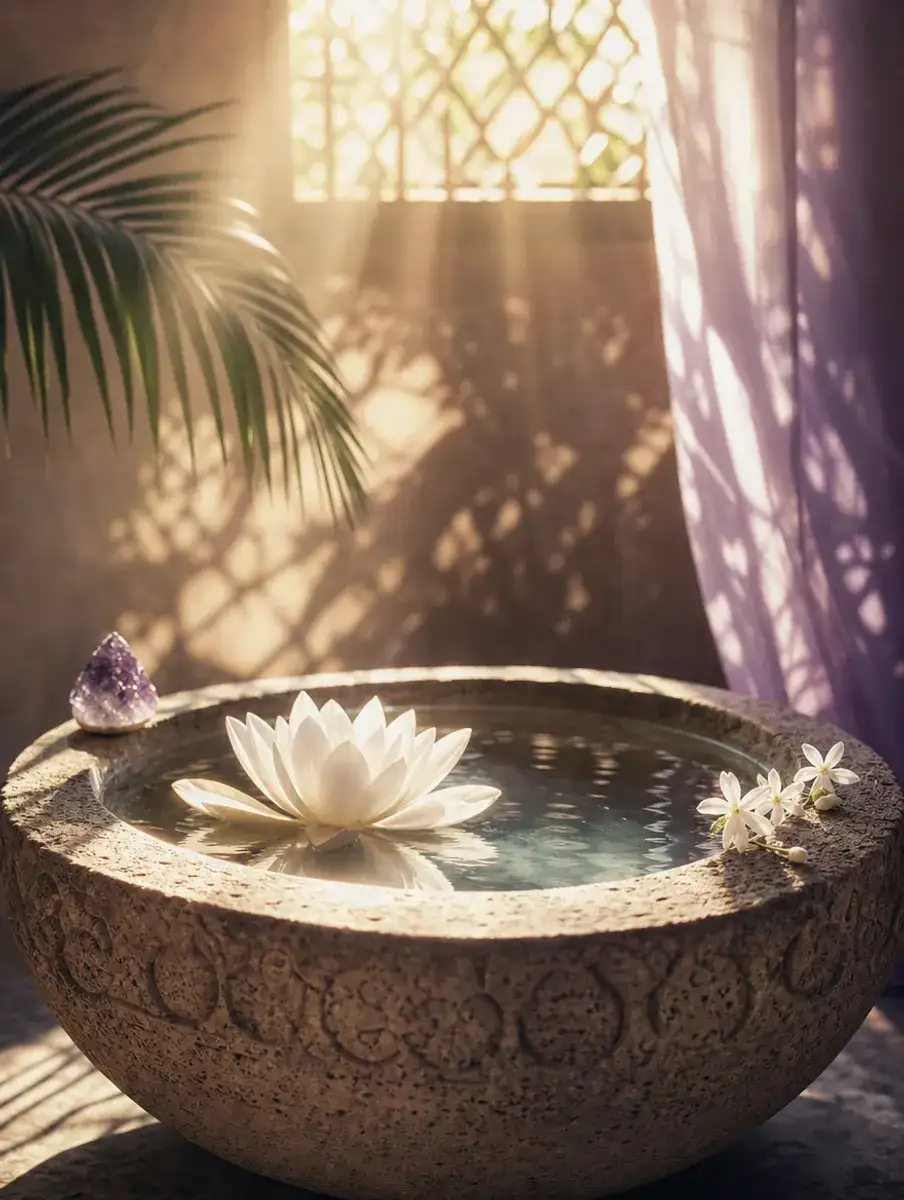
The crown chakra is sahasrara, the seventh and highest centre in the modern chakra system, placed at or just above the top of the head. Tantric and hatha texts picture it as a lotus of a thousand petals and describe it as the goal of kundalini practice. It is a traditional symbol, not a physical structure.
The crown chakra is sahasrara, the seventh and last centre in the modern chakra system. It is placed at the crown of the head or just above it, and it is pictured as a lotus with a thousand petals.
This page describes sahasrara as the texts and the tradition describe it. It makes no claim that a chakra exists physically, can be opened or activated, or that any practice acts on it.
What does the crown chakra look like in the texts?
The best-known description comes from the Sat-cakra-nirupana, a sixteenth-century text that shaped the seven-chakra system used in studios today. Its English translation, The Serpent Power, appeared in 1919.
In that text, the lotus at the crown hangs with its face turned downward, and it is more lustrous than the full moon. Its thousand petals carry the fifty letters of the Sanskrit alphabet, repeated many times over. Every sound, in other words, is gathered here.
The lower five centres each hold one of the five elements. The sixth, ajna, sits beyond the elements. The crown sits beyond even that. The texts describe it as the seat of Shiva, pure consciousness, and in some readings as a void or emptiness rather than a place.
That is why the text counts six chakras along the body and treats sahasrara separately. In the modern list it simply became number seven.
What part does the crown play in kundalini lore?
In the tantric and hatha texts, kundalini is a force pictured as a serpent coiled at the base of the spine. As those texts present it, practice rouses this force and draws it upward through each centre in turn. Its arrival at the crown, where it unites with Shiva, is described as the goal.
The texts also speak of amrita, a nectar said to be stored at the head. They describe it in symbolic language that later teachers have read in many ways.
All of this belongs to a detailed, demanding practice that the texts say must be learned from a teacher. The page on kundalini awakening sets out what the tradition says about it, and the page on Kundalini Yoga covers the modern style that took the name.
Where do the modern ideas come from?
Twentieth-century Western writers added a new layer. They gave the crown the colour violet, paired it with the pineal or pituitary gland, and linked it with spirituality and higher awareness. None of these pairings comes from the Sanskrit texts, and there is no evidence that any practice changes a gland through the crown. Scholars of tantra usually treat this material as a recent reinterpretation.
Why a lotus?
The lotus grows from mud and opens clean above the water, which made it a natural image for rising out of ordinary life. Every centre in the system is drawn as a lotus, the flower that runs through Hindu and Buddhist symbolism. The crown is simply the largest, with the most petals, at the top of the climb.
How does sahasrara come up in a modern class?
In most classes the crown comes up as a cue for posture. “Lengthen through the crown of the head” asks you to grow tall through the spine in Mountain Pose or a seated meditation, without lifting the chin.
Some teachers name sahasrara during a closing meditation, as a place to rest the attention at the top of the head. Treat that as a way of focusing. It makes no promise about what happens inside the body, and you can follow the breath instead if you prefer.
Browse all yoga philosophy pages.
Sources: Mayo Clinic, Fitness program: 5 steps to get started; NCCIH (US National Institutes of Health), Yoga: Effectiveness and Safety. Last reviewed 2 October 2026.
Questions
What does sahasrara mean?
Sahasrara means thousand-spoked or thousand-petalled, from sahasra, a thousand. The full name is often given as sahasrara padma, the thousand-petalled lotus. A thousand here suggests something countless rather than an exact number.
Is the crown chakra one of the seven chakras?
In the modern list it is the seventh. The Sat-cakra-nirupana, the text behind that list, actually names six centres along the body and treats the lotus above the head as something different in kind, the place where the six are left behind.
What colour is the crown chakra?
Modern charts make it violet or white, the last colour of a rainbow sequence. The older Sanskrit description speaks of a lotus more lustrous than the full moon, with petals bearing the letters of the alphabet. The rainbow scheme is a twentieth-century Western addition.
Does the crown chakra have a seed syllable?
The lower centres each have one bija, or seed syllable. The older description of sahasrara does not give it a single syllable in the same way, since its petals carry every letter. Modern charts sometimes assign it om, or silence.
What does the crown chakra do in yoga tradition?
In the tantric and hatha texts, the crown chakra is where kundalini, pictured as a coiled serpent, finally arrives and unites with Shiva, pure consciousness. It is described as the goal of that practice, beyond the elements of the lower centres. It is a traditional symbol, and this page makes no claim that it exists or acts physically.
Can the crown chakra be blocked or activated?
The Sanskrit texts do not talk about a blocked crown chakra. Ideas of blocking, opening and activating, along with colours and glands, come from twentieth-century Western writers. In the older texts, reaching the crown is the goal of a demanding kundalini practice learned from a teacher. In a class, the crown is mostly a cue to lengthen the spine.
Keep reading
Your yoga calendar
We track every yoga event, workshop and pop-up class so you don't have to.
Updated