Guides · reviewed by a teacher
Yoga for beginners: how to start, however stiff you feel
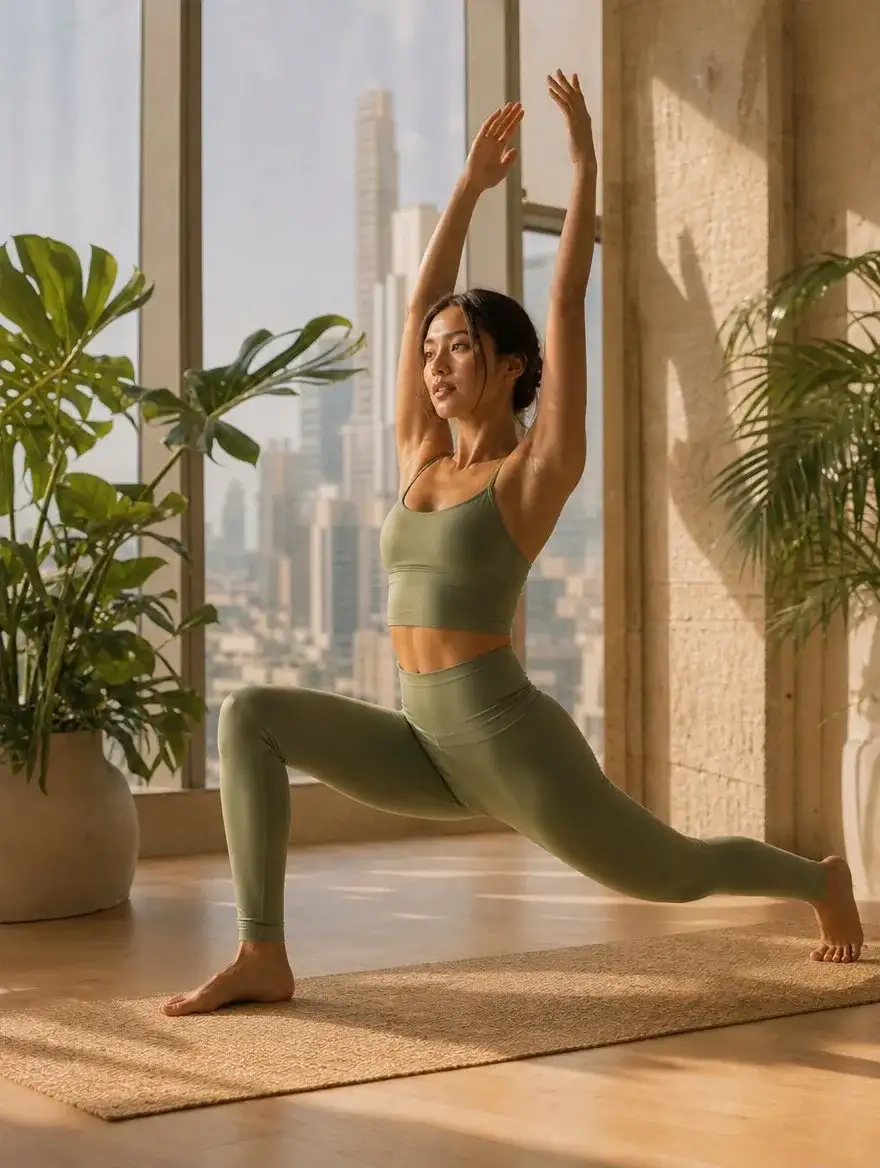
You do not need to be flexible, fit or calm to start yoga, because those are things the practice works on, not things it asks for at the door. Start with a handful of simple poses, a slow pace and a teacher who changes the shapes to fit your body, and build from there.
Teacher's note from Joahnna Lee
“In a first lesson I spend the early minutes asking how your body feels and what you want from the practice, then we learn the basic shapes slowly, with every prop within reach.”
“If something does not suit you, we change it.”
If you feel stiff, out of shape, or a little embarrassed about how you will look on a mat, you are in exactly the right place to begin. The practice is built to meet you where you are, at a pace that suits you.
What you actually need
Less than you think. A mat, clothes you can move in, and some floor space. Blocks and a strap help, because they bring the floor closer to you, but you can use a stack of books and a belt at home. When you are ready to buy, see the best yoga mats in the Philippines.
You do not need to be flexible. You do not need to be strong. You do not need to know any Sanskrit, and you do not need to be good at sitting still. All of those come, slowly, from practising. None of them are the price of entry. If you are wondering how a class differs from a few minutes of stretching, yoga vs stretching sets the two side by side.
What to wear to yoga (at home and in a class)
Choose clothes that stay where you put them. When you fold forward or lift your hips in Downward Dog, where a loose top slides towards your chin, a fitted top keeps you covered and lets you forget about it. Leggings, cycling shorts or soft track pants all work; very baggy trousers catch on your feet and hide your knees, which makes it harder to see how you are standing.
Manila is warm and humid most of the year, so pick light, breathable fabric over heavy cotton that stays damp. Bring a small towel for your hands and face, and a layer for the end, because you cool down quickly lying still, especially under an air conditioner.
Practise barefoot. Bare feet grip the mat better than socks, and you can feel how your weight spreads. Take off rings and bracelets that press into your hands, and tie long hair low so it is comfortable when you lie on your back. The full guide to what to wear to yoga covers the rest. If you want leggings or joggers made for practice, yoga pants and outfits compares fabrics and fit, and the guide to grip socks for yoga explains when socks make sense.
Which poses come first?
A few shapes come up in almost every beginner class: Mountain pose, Child’s pose, Cat-cow, Downward dog and lying still at the end. Child’s pose is your resting pose, and you can come into it at any point in a class, for any reason, without asking. In Downward dog, bend your knees generously; straight legs and flat heels are not the goal. Start with these 12 yoga poses for beginners, then put them together in a 20-minute beginner sequence.
How to start, step by step
Go slowly. Move at a pace where you can still breathe through your nose. If you are holding your breath, ease off.
Use props from the first day. A block under your hand is not a sign you are behind. It is how the pose is meant to be done in your body today.
Work at about seventy percent. You should feel the shape working, never a sharp or pinching sensation. Discomfort that is dull and spread out is usually fine. Anything sharp, or anything in a joint, means come out. The yoga texts call this not harming, or ahimsa, and it comes before any pose.
Keep it regular. A short practice twice a week tends to do more than one long practice a month, which the Yoga Sutras put as practice “followed long, persistently, with earnestness”, one of the classical yoga quotes worth keeping. Between classes, a fifteen-minute head-to-toe stretch or a gentle morning stretch beside the bed keeps the body used to moving. For weekly rhythms by goal, see how often you should do yoga.
Ignore the person next to you. Every body folds differently, and some bodies will never do some shapes. That is anatomy, not failure. The guide to common yoga mistakes beginners make covers this and other habits worth unlearning.
A four-week plan for your first month
- Week 1: two sessions of 15 to 20 minutes. Learn the five poses above, slowly, with props. Finish each session lying still for two minutes.
- Week 2: two or three sessions. Add a couple of slow rounds of Sun Salutation with the knees down after Cat-Cow.
- Week 3: take one beginner class at a studio, or follow one longer home session of about 30 minutes. Notice which poses feel easier than in week 1.
- Week 4: three sessions, one of them a class. Keep a short note of how you feel after each, so you can see which style and time of day suits you.
If a week gets busy, repeat it rather than skipping ahead. For a session-by-session version with every pose linked, a printable plan and a checklist, follow the 4-week beginner yoga program.
How long before you notice a difference?
Many beginners notice small changes within the first two or three weeks of practising twice a week: getting into and out of poses with less effort, breathing more slowly in Child’s Pose, feeling less stiff on the morning after. Changes in flexibility and strength usually take longer, often a couple of months of regular practice. Everyone’s starting point is different, so compare yourself with your own first week, not with anyone else.
Practising at home in a small space
A strip of floor the length of a mat and an arm’s width either side is enough for everything on this page. Push the coffee table aside, put the mat on a non-slip surface rather than a loose rug, and practise when the room is coolest: early morning before the traffic, or in the evening with a fan on. Keep water and a hand towel at the top of the mat.
Should a beginner start with hot yoga?
It is usually easier to learn the shapes first in a room at normal temperature, then try a heated class once the poses feel familiar. Manila’s climate already makes many rooms warm. If you do try hot yoga, drink water through the day beforehand, rest in Child’s Pose whenever you need to, and leave the room if you feel dizzy or sick.
Which style to start with
Most beginners do well with a slow, alignment-focused class first, where you learn the names and the shapes before the pace picks up. From there, some people move towards a flowing style like Vinyasa and some towards a still, floor-based style like Yin. For the difference between held and flowing classes, see hatha vs vinyasa, or take the yoga style quiz. If sitting still is the hard part, laughter yoga, a playful group practice with no poses, is another way in. Men who feel stiff starting out will find tips in yoga for men.
When to check with a professional first
Yoga is gentle, but it is still movement. Check with your doctor before you start if you have a heart or blood pressure condition, a recent injury or surgery, ongoing joint or back pain, or if you are pregnant or have recently given birth. If you are pregnant, look for a prenatal class once your OB or midwife has cleared you.
A physiotherapist is the right person to ask if a particular movement hurts. Tell your teacher about any of these before your first class so the practice can be planned around them.
Your first class
A good first class starts with the teacher asking how your body feels and what you want from the practice, then teaches the basic shapes slowly, with props within reach. If something does not suit you, it gets changed. The class ends lying down. Your first yoga class walks through the day itself, and the free community sessions held around International Yoga Day each June are an easy first taste.
Some beginners prefer a few one-to-one sessions before joining a room full of people; the comparison of private yoga and group classes helps you weigh the two. To find a beginner-friendly class, browse yoga studios across the Philippines. And if one day you want to share the practice, read how to become a yoga teacher.
Weighing yoga against other low-impact classes? Our pilates vs yoga comparison sets the two side by side.
Browse the guides section.
Sources: Mayo Clinic, Fitness program: 5 steps to get started; NCCIH (US National Institutes of Health), Yoga: Effectiveness and Safety; NHS, Exercise in pregnancy; CDC, Pregnant & Postpartum Activity: An Overview; Canadian Family Physician (Chan et al., 2014), via PubMed Central, Hot yoga and pregnancy: Fitness and hyperthermia. Last reviewed 2 October 2026.
Questions
Am I too inflexible to start yoga?
No. Most people who start yoga cannot touch their toes, and nobody needs to. Every pose has a version that works for a stiff body, usually with a block, a strap or bent knees. Inflexibility is a starting point, not a reason to wait.
How often should a beginner do yoga?
Once or twice a week is a good start. What matters more than the number is doing it regularly, so choose a rhythm you can keep. A few minutes of the basic poses on the days in between can help the shapes feel familiar sooner.
Can I learn yoga at home as a complete beginner?
Yes. A mat and a quiet corner are enough to begin. The one thing home practice from a video cannot give you is someone watching how you move, which is why many beginners start with a few classes with a teacher and then practise on their own.
What should I wear to my first yoga class?
Something you can move and bend in that stays put when you fold forward. Leggings or soft shorts and a fitted top work well. You practise barefoot, so no special shoes are needed.
Is yoga a good workout for beginners?
It depends on the style. Gentle Hatha and beginner classes build strength, balance and ease of movement at a steady pace, while Vinyasa and power classes add more sweat and heart rate. Starting with a gentle or beginner class lets you learn the basic poses safely before trying the faster styles.
How long is a typical beginner yoga class?
Most studio classes run about 45 to 75 minutes, with an hour being common. That usually includes a few minutes of settling and breathing, a warm-up, the main poses and a few minutes of rest at the end. At home, even 15 to 20 minutes is a useful practice when you are starting out.
Do you need to bring your own yoga mat to a studio?
Not always. Many studios lend or rent mats, but policies differ, so check before your first class. If you plan to go regularly, your own mat is more hygienic and you get used to its grip. A small towel is useful too, since hands and feet can sweat in warm rooms.
Keep reading
Your yoga calendar
We track every yoga event, workshop and pop-up class so you don't have to.
Updated